

1
3


✔ In stock and ready to ship
🚚 Order within calculating... to receive it by
calculating...
✅ Fully tracked delivery on every order
📦 Tracking details sent instantly when your order ships
- Free US shipping on orders over $99 · $3.99 under $99
- Dispatched in 1–2 business days · delivery in 3–7 business days from dispatch via USPS (US only)
- 14-day returns from the date of delivery
⭐⭐⭐⭐⭐ 4.8/5 rating from 7,500+ verified customers
🔒 Secure checkout with Visa, Mastercard, Amex, PayPal & Shop Pay
SKU:
PLD22444
Barcode:
9782527513010
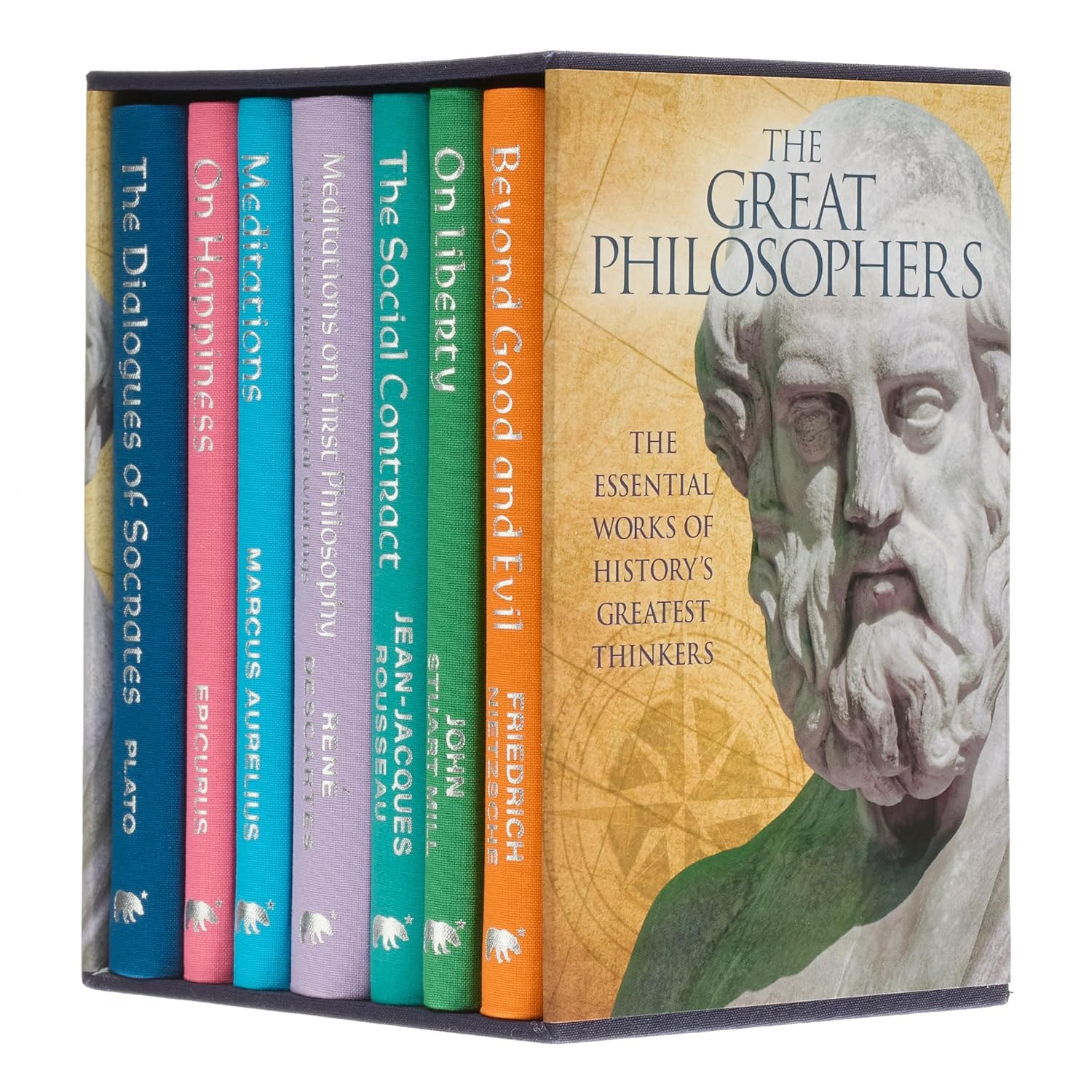
Titles in This Set
The Dialogues of Socrates by Plato
On Happiness by Epicurus
Meditations by Marcus Aurelius
Meditations on First Philosophy and Other Metaphysical Writings by René Descartes
The Social Contract by Jean-Jacques Rousseau
On Liberty by John Stuart Mill
Beyond Good and Evil by Friedrich Nietzsche
Details
Condition: Brand New
Format: Hardback
Publisher: Arcturus
Overview
This seven-volume hardback collection gathers some of the most influential voices in Western philosophy into one elegant, giftable set. From Plato's probing dialogues to Nietzsche's fierce critique of conventional morality, each clothbound volume invites slow, thoughtful reading on virtue, freedom, happiness, and the nature of a just society. Bound in the Arcturus Collector's Classics style, these books are built to be read, reread, and displayed. Whether you're a student building a foundation in classical thought or a lifelong reader drawn to big questions, this set offers a rich, accessible doorway into the ideas that shaped modern civilization.
About the Books
Spanning roughly 2,300 years of thought, this collection traces philosophy's evolution from ancient Athens to the eve of the twentieth century. Plato's Dialogues of Socrates opens the set with the question-and-answer method that defined Western philosophical inquiry, presenting Socrates in conversation as he tests his fellow Athenians' assumptions about virtue, justice, and knowledge. Epicurus's On Happiness distills a practical ethic centered on modest pleasure, freedom from anxiety, and lasting friendship. Marcus Aurelius's Meditations brings Stoic philosophy into intimate focus, recording a Roman emperor's private reflections on duty, mortality, and inner discipline, written as personal notes rather than a formal treatise. The set then leaps forward with Descartes's Meditations on First Philosophy, the work that reoriented epistemology around the thinking self and introduced methodical doubt as a tool for building certain knowledge. Rousseau's The Social Contract lays out an influential theory of political legitimacy built on the general will, a text that echoed through later democratic revolutions. Mill's On Liberty makes the classic case for individual freedom of thought and speech, arguing that a healthy society depends on protecting dissent. The collection closes with Nietzsche's Beyond Good and Evil, a provocative challenge to inherited moral assumptions that continues to unsettle and inspire readers today. Together, these seven works form a coherent arc from ancient ethics through Enlightenment political theory to modern philosophical rebellion, making the set a genuinely useful survey rather than a random grouping of classics.
Key Benefits
- Seven foundational philosophy texts in one cohesive hardback set
- Clothbound Arcturus Collector's Classics styling for a handsome shelf display
- Covers ancient ethics, Stoicism, Enlightenment political theory, and modern philosophy
- Accessible for students, book clubs, and general readers alike
- A durable keepsake edition built for rereading and reference
- A thoughtful gift for graduates, philosophy students, or curious readers
Book-by-Book Guide
The Dialogues of Socrates — Plato's question-driven dialogues model the Socratic method and probe virtue, justice, and knowledge through conversation.
On Happiness — Epicurus's writings distill a practical ethic centered on simple pleasures and the value of friendship.
Meditations — Marcus Aurelius records private Stoic reflections on duty, mortality, and disciplined living.
Meditations on First Philosophy and Other Metaphysical Writings — René Descartes builds a new foundation for knowledge through methodical doubt and the famous cogito argument.
The Social Contract — Jean-Jacques Rousseau argues that legitimate political authority rests on the general will of the people.
On Liberty — John Stuart Mill makes an influential case for protecting individual freedom of thought and speech.
Beyond Good and Evil — Friedrich Nietzsche challenges inherited moral assumptions and the foundations of traditional ethics.
About the Authors
This set brings together seven towering figures in philosophy. Plato, a student of Socrates, founded the Academy in Athens and shaped nearly all later Western thought. Epicurus taught a philosophy of measured pleasure and tranquility in ancient Greece. Marcus Aurelius ruled Rome as emperor while privately practicing Stoic philosophy. René Descartes, a French mathematician, is often called the father of modern philosophy. Jean-Jacques Rousseau was a Genevan-born Enlightenment thinker whose ideas influenced modern democracy. John Stuart Mill, an English philosopher, championed liberty and utilitarian ethics. Friedrich Nietzsche, a German philosopher, remains a provocative critic of conventional morality.
Why You'll Love This Collection
This handsome hardback set makes a memorable gift for a graduation, a birthday, back-to-school reading, or the holiday season, and an equally great addition to a home library, book club, or classroom collection. Seven essential thinkers in one cohesive keepsake edition offer endless conversations for any curious reader to enjoy for years to come.
Please Note: This is the UK edition with the ISBN as listed; the cover may vary slightly from the image shown.
- Choosing a selection results in a full page refresh.