

1
5


✔ In stock and ready to ship
🚚 Order within calculating... to receive it by
calculating...
✅ Fully tracked delivery on every order
📦 Tracking details sent instantly when your order ships
- Free US shipping on orders over $99 · $3.99 under $99
- Dispatched in 1–2 business days · delivery in 3–7 business days from dispatch via USPS (US only)
- 14-day returns from the date of delivery
⭐⭐⭐⭐⭐ 4.8/5 rating from 7,500+ verified customers
🔒 Secure checkout with Visa, Mastercard, Amex, PayPal & Shop Pay
SKU:
PLD15249
Barcode:
9789123541898
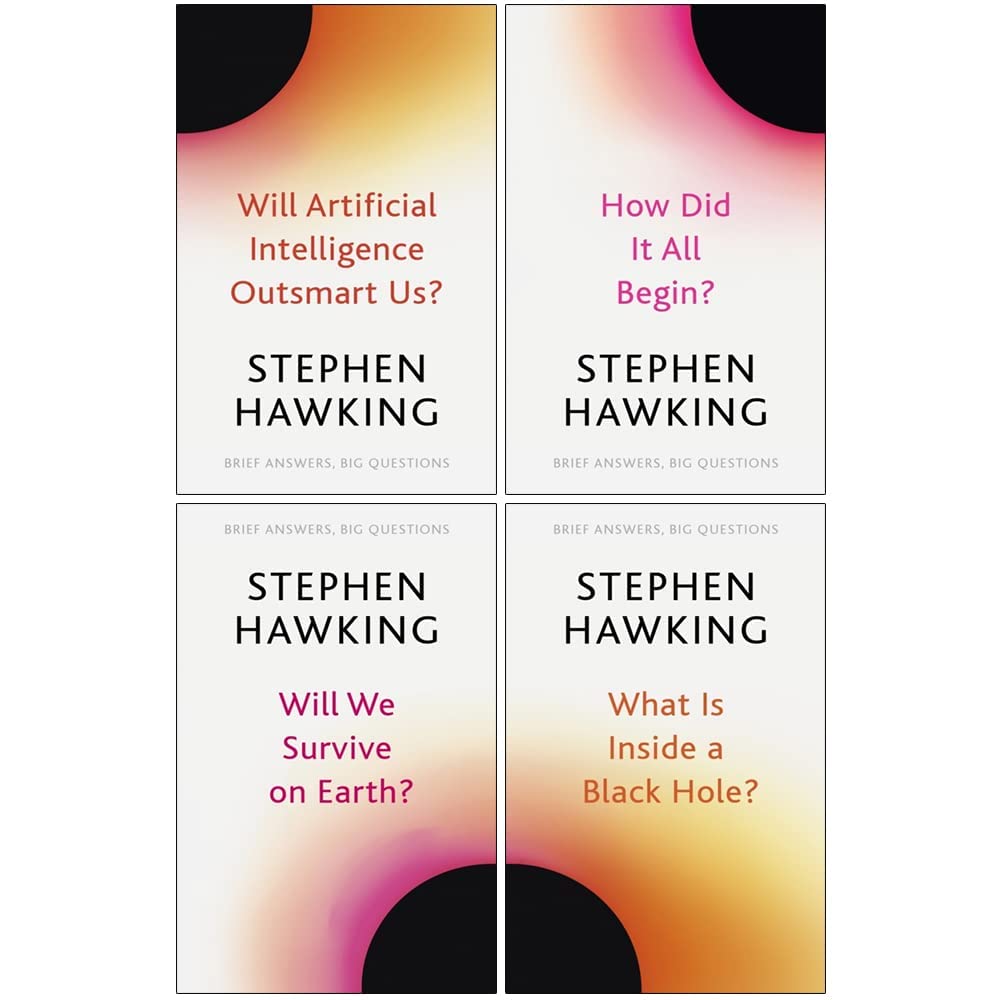
Titles in This Set:
Will Artificial Intelligence Outsmart Us?
How Did It All Begin?
Will We Survive on Earth?
What Is Inside a Black Hole?
Condition: [Keep exactly as provided, or omit this line if not provided]
Format: Paperback
ISBN: [Keep exactly as provided, or omit if unknown]
Overview:
This four‑book collection brings together Stephen Hawking’s accessible yet expansive explorations of the biggest questions in science and existence. Written for the curious reader who wants clear explanations of complex ideas, these titles distill Hawking’s century‑spanning insights into concise, compelling essays. The set sits firmly in the Brief Answers, Big Questions line, presenting Hawking’s signature blend of awe, rigor, and wit. This paperback collection suits fans of popular science, philosophy, and cosmology who crave thoughtful reflections on AI, the origins of the cosmos, humanity’s future, and the mysteries of black holes. It’s an ideal gift set for graduates, science enthusiasts, and readers seeking a credible entry point into profound topics without sacrificing intellectual depth. Together, the books offer a coherent journey through how we understand reality, time, space, and our place within it, all through Hawking’s distinctive voice and approachable prose.
What This Collection Covers:
Across these four titles, Hawking surveys the landscape of modern science with questions that resonate beyond the laboratory. Will Artificial Intelligence Outsmart Us? probes the future of machine intelligence, the potential risks, and the implications for human identity. How Did It All Begin? turns the spotlight on the origins of the universe, the role of a possible creator, and the meaning we ascribe to existence. Will We Survive on Earth? presses the urgent question of planetary stewardship and whether humanity must look outward to space for a sustainable future. What Is Inside a Black Hole? guides readers into the physics of time, space, and the enigmatic inner workings of black holes, touching on time travel and the nature of reality. The collection therefore blends rigorous science with philosophical reflection, inviting readers to think critically about technology, fate, and the boundaries of what we can know. It’s a complete series in miniaturized form—short essays that pack big ideas into digestible chapters—perfect for readers building their science literacy and curiosity.
Book-by-Book Guide:
Will Artificial Intelligence Outsmart Us? explores whether machines could surpass human intelligence and what that would mean for our future. Hawking presents accessible explanations of AI’s possibilities and limitations, carefully weighing benefits against risks. The book is as much a meditation on human values as it is a technological forecast, encouraging readers to consider governance, ethics, and the societal choices that shape intelligent systems. Hawking’s crisp questions serve as a map for readers facing the rapid evolution of technology, making it ideal for thoughtful discussions at home or in classrooms.
How Did It All Begin? invites readers to grapple with the origins of existence, the possible role of a creator, and the nature of reality. Hawking surveys cosmology, quantum theory, and philosophical perspectives to illuminate how scientists approach the big questions. The tone remains inviting for newcomers while rewarding for readers already versed in science, providing a concise tour through the big ideas about beginnings, time, and the structure of the universe. It’s both a primer and a nudge toward deeper inquiry, perfect for curious readers who enjoy pondering the ultimate causes of our world.
Will We Survive on Earth? shifts the focus to humanity’s long‑term prospects. Hawking discusses climate, risks to civilization, and the argument for expanding beyond Earth as a hedge against existential threats. The author’s thoughtful appraisal of risks and opportunities offers a sober but hopeful view of our species’ resilience, encouraging readers to consider real‑world actions—from science education to space exploration—that could shape a sustainable future. This title resonates with readers who want science to inform practical choices and policy discussions.
What Is Inside a Black Hole? leads readers into one of physics’ most captivating frontiers: the interior of black holes and the nature of time itself. Hawking explains how gravity and quantum mechanics interact, why black holes tempt us with paradoxes, and how these ideas influence our understanding of space and time. The discussion balances conceptual clarity with imaginative exploration, inviting readers to imagine time travel and the limits of human knowledge. It’s a compelling closer to the set for anyone drawn to cosmic mysteries and the beauty of theoretical physics.
Who This Set Is Perfect For:
This collection is ideal for inquisitive readers who crave thoughtful, literature‑level science without the dense jargon. It suits high‑schoolers and adults exploring popular science, lifelong learners building a foundation in cosmology and technology ethics, and book clubs seeking accessible discussions about future realities and space exploration. Gift buyers will appreciate a complete, cohesive set that educates and inspires, while teachers and parents can use the four titles to spark curiosity about physics, astronomy, AI ethics, and the human story within the universe. Fans of Hawking’s broader bibliography or readers who enjoyed A Brief History of Time will find these essays approachable entries into the author’s enduring curiosity about the cosmos.
Key Benefits:
- Concise, thought‑provoking introductions to AI, the cosmos, Earth’s future, and black holes
- Accessible paperback edition format suited for gifting and quick reading sessions
- Perfect for book clubs and classroom discussions on science, ethics, and philosophy
- Clear explanations that empower readers to engage with complex ideas confidently
- Part of the renowned Brief Answers, Big Questions series for consistent quality
- Great complement to Hawking’s broader works for a holistic science journey
About the Author:
Stephen Hawking was a world‑renowned British theoretical physicist celebrated for translating the most profound questions of science into accessible, engaging prose. As the author of A Brief History of Time and a leading voice in cosmology and the study of black holes, Hawking’s work bridged rigorous theory and public imagination. The Brief Answers, Big Questions collection that these titles belong to reflects his lifelong commitment to exploring fundamental mysteries—time, space, life beyond Earth, and the role of human intellect in shaping the future. Though he passed away in 2018, Hawking’s legacy endures in these succinct, lucid essays that invite readers to diverge from certainty and embrace curiosity.
Why You’ll Love This Set:
A complete, coherent traversal through Hawking’s most accessible scientific inquiries, this four‑book collection delivers a unified reading experience: the questions are big, the answers are thoughtful, and the pace respects the reader’s curiosity. Owning the full set means you have a portable syllabus for exploring AI ethics, cosmic origins, planetary futures, and the physics of time—ideal for personal study, classroom use, or thoughtful gifting. If you’re building a science shelf that both educates and inspires conversation, this collection is a smart, enduring addition.
Please Note: The individual books included in this listing will be dispatched as per the original UK ISBN and UK edition cover image shown in the image.
- Choosing a selection results in a full page refresh.