

1
9


🚚 Order within calculating... to receive it by
calculating...
✅ Fully tracked delivery on every order
📦 Tracking details sent instantly when your order ships
⭐⭐⭐⭐⭐ 4.8/5 rating from 7,500+ verified customers
🔒 Secure checkout with Visa, Mastercard, Amex, PayPal & Shop Pay
SKU:
MAN-PR-RT-U020425-9781804454183
Barcode:
9781804454183
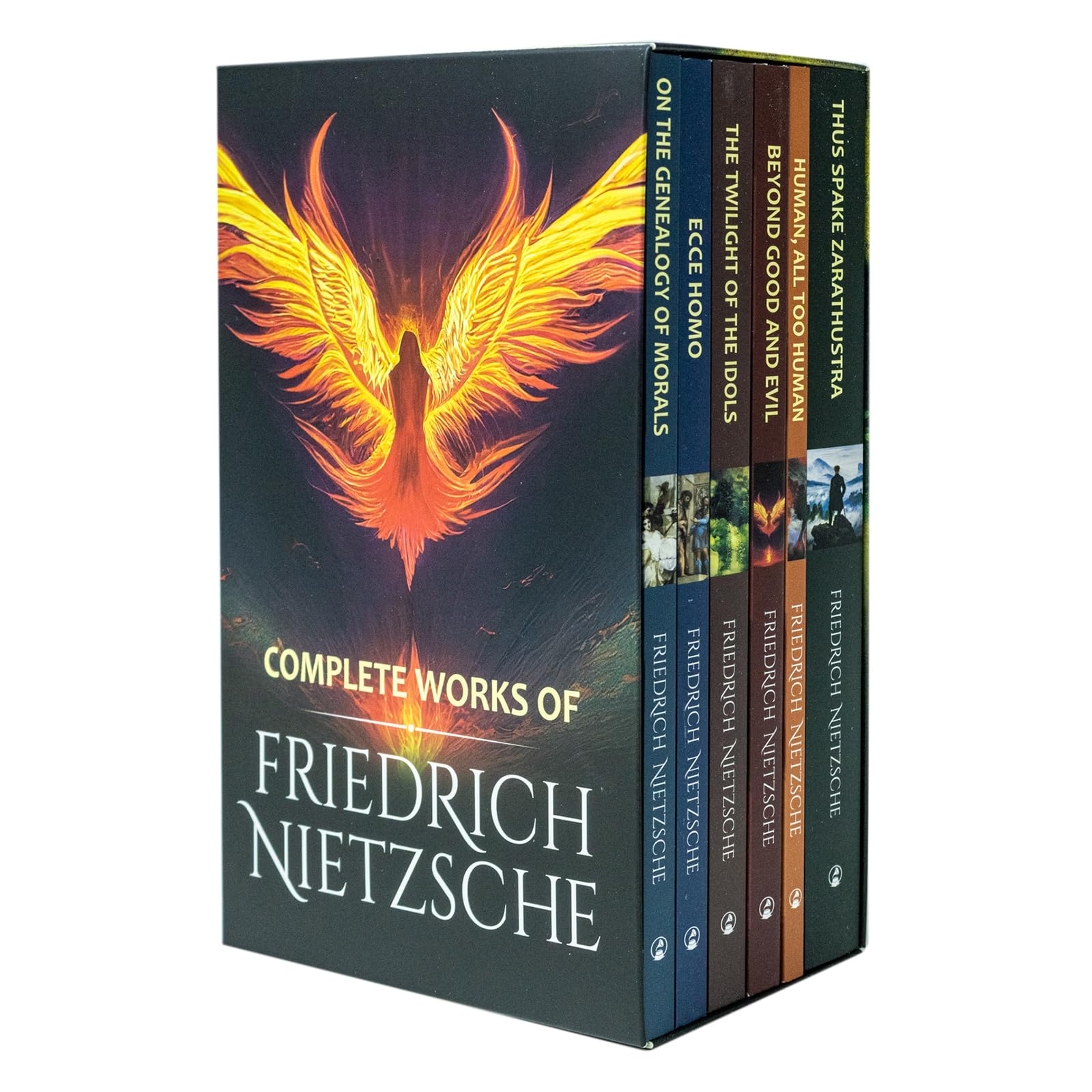
Titles in This Set:
Thus Spake Zarathustra
Human, All Too Human
Beyond Good and Evil
The Twilight of the Idols
Ecce Homo
On the Genealogy of Morals
Format: Paperback
ISBN:
Overview:
This Complete Works Of Friedrich Nietzsche 6 Book Collection brings six of the philosopher’s most influential titles into one portable, affordable paperback set. Carefully curated to trace Nietzsche’s developing thought from early aphorisms to more mature critiques, the collection provides a cohesive entry point for readers new to his work and a compact reference for students and scholars alike. The titles—Thus Spake Zarathustra, Human, All Too Human, Beyond Good and Evil, The Twilight of the Idols, Ecce Homo, and On the Genealogy of Morals—each offer a distinct lens on morality, culture, religion, and the nature of human flourishing. Whether you’re studying philosophy, literature, or social theory, this six-book collection supports deep reading, rigorous annotation, and meaningful debate. It is an essential addition to any library seeking a comprehensive, practical route into Nietzsche’s enduring influence on modern thought.
What This Collection Covers:
Across these six works, readers encounter Nietzsche’s bold interrogation of traditional values, the foundations of morality, and the cultural forces shaping belief. The collection moves from lyrical, speculative prose to sharp, methodical critique, illustrating how Nietzsche’s questions evolved over time. Readers explore how culture, religion, and power interact to shape our sense of right and wrong, how individuals confront meaning, and why philosophy remains a living conversation. This set is especially valuable for those pursuing seminars on existentialism, moral psychology, and the history of Western philosophy, offering both a broad survey and precise, targeted arguments that invite reflection and discussion.
Book-by-Book Guide:
Thus Spake Zarathustra—This iconic work unfolds as a prophetic journey, blending literary parable with philosophical argument to challenge conventional morality and cultural assumptions. Zarathustra’s encounters, episodes, and aphorisms invite readers to rethink values, destiny, and how one might live with authenticity. The book’s poetic cadence, provocative imagery, and daring ideas reward careful reading, annotation, and dialogue. It functions as a philosophical narrative that pushes readers to examine their own beliefs about purpose, meaning, and the potential for personal transformation in a modern world saturated with competing ideologies.
Human, All Too Human—A collection of aphorisms and essays that adopts a more empirical tone, questioning metaphysical certainties and urging a shift toward reason, science, and self-critique. Nietzsche examines morality, religion, art, and culture through a skeptical lens, presenting ideas in concise, often biting observations. The work is accessible to students of philosophy and readers exploring secular humanism, offering compact arguments that reward close reading and cross-referencing with his other writings.
Beyond Good and Evil—A rigorous reevaluation of traditional moral categories and the conditions under which values arise. This book delves into the psychology of belief, the critique of philosophy, and the critique of dogma, laying groundwork for Nietzsche’s later inquiries into power, culture, and civilization. It’s a demanding but richly rewarding text for readers ready to engage with bold, systematic critiques and to map Nietzsche’s development as a thinker who reshaped modern ethics.
The Twilight of the Idols—A compact, polemical survey that targets widely accepted beliefs and cultural idols. Nietzsche distills his critique into bite-sized essays, offering pointed analyses of religion, philosophy, aesthetics, and social norms. The work serves as an accessible entry point for newcomers and a precise compendium for seasoned readers, illustrating how Nietzsche destabilizes entrenched ideas while proposing a more independent, questioning stance toward truth and value.
Ecce Homo—A self-portrait of the philosopher that blends autobiography with reflection on his own ideas and their reception. This provocative work invites readers to consider how Nietzsche understood his life’s work, his strengths, and the controversial reception of his theories. It offers insight not only into the man behind the philosophy but also into the challenges of communicating radical thought within the cultural currents of his time.
On the Genealogy of Morals—A seminal examination of the origins and development of moral concepts. Using a genealogical method, Nietzsche traces how guilt, ascetic ideals, and social conventions evolved, challenging readers to rethink the historical roots of “good” and “evil.” The work combines historical analysis with philosophical argument, encouraging readers to see morality as a human creation shaped by power relations and cultural pressures rather than as timeless absolutes.
Who This Set Is Perfect For:
This six-title collection is ideal for philosophy students, serious readers of literature and cultural criticism, and anyone building a foundational library in moral philosophy. It suits study groups, university courses, and personal libraries where rigorous argument and provocative ideas are valued. The paperback format supports easy annotation, comparison across translations, and on-the-go study. Gift buyers will appreciate a cohesive, durable introduction to Nietzsche’s most influential works, while lifelong readers will relish a consolidated resource for ongoing exploration of meaning, power, and human conduct.
Key Benefits:
- Comprehensive six-title Nietzsche collection in one affordable paperback set
- Great for study and discussion; ideal for coursework and self-guided learning
- Portable, paperback edition suitable for annotation and casual reading
- Shows thought progression across Nietzsche’s career from early to late works
- Supports philosophy, literature, and cultural studies curricula and inquiry
- Thoughtful gift set for students, academics, and curious readers
About the Author:
Friedrich Nietzsche (1844–1900) was a German philosopher whose writings reshaped modern thought. He is known for incisive critiques of morality, religion, and culture, and for exploring how values arise, how power operates in society, and how individuals create meaning. His style blends aphorism, narrative, and rigorous argument, inviting readers to question conventional wisdom and to consider new possibilities for human flourishing. The six works in this collection reflect Nietzsche’s enduring influence on existentialism, continental philosophy, and readings of culture, ethics, and psychology. Nietzsche’s provocative approach continues to inspire debate and reinterpretation across philosophy, literature, and social theory.
Why You’ll Love This Set:
Owning the complete set in one compact package provides a coherent lens on Nietzsche’s thought and a durable reference for years of study and reflection. The paperback format makes it easy to annotate, compare translations, and carry from classroom to library shelf. Readers gain breadth and depth—six essential titles that illuminate how Western philosophy interrogates morality, power, and meaning. This set is a thoughtful gift for students, professors, and curious readers who relish bold ideas that challenge convention and invite deeper inquiry.
Please Note: The individual books included in this listing will be dispatched as per the original UK ISBN and UK edition cover image shown in the image.
- Choosing a selection results in a full page refresh.