

1
4


✔ In stock and ready to ship
🚚 Order within calculating... to receive it by
calculating...
✅ Fully tracked delivery on every order
📦 Tracking details sent instantly when your order ships
- Free US shipping on orders over $99 · $3.99 under $99
- Dispatched in 1–2 business days · delivery in 3–7 business days from dispatch via USPS (US only)
- 14-day returns from the date of delivery
⭐⭐⭐⭐⭐ 4.8/5 rating from 7,500+ verified customers
🔒 Secure checkout with Visa, Mastercard, Amex, PayPal & Shop Pay
SKU:
PLD24784
Barcode:
9789124315306
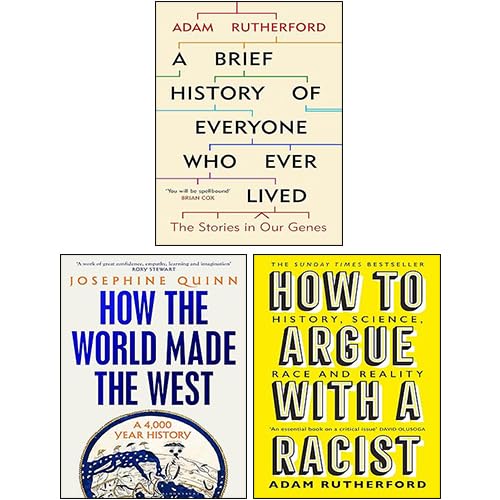
Titles in This Set:
How the World Made the West
A Brief History of Everyone Who Ever Lived
How to Argue With a Racist
Format: Paperback
Overview:
This three-book non-fiction collection brings together a provocative mix of history and science that reframes big questions about how we got here. How the World Made the West challenges the traditional, single-civilisation narrative by tracing thousands of years of global encounters that shaped the Western world as we know it. A Brief History of Everyone Who Ever Lived invites readers to view humanity’s story through our shared DNA, migrations, and historical events that connect all 100 billion humans who have ever lived. How to Argue With a Racist confronts dangerous ideas with clear, evidence-based reasoning about genetics, evolution, and human difference, offering practical tools for constructive dialogue. Together, these titles encourage curiosity, critical thinking, and a more nuanced understanding of history, science, and society. This collection is ideal for curious adults, students, and anyone who loves accessible, rigorous non-fiction that invites fresh perspectives on who we are and where we come from.
What This Collection Covers:
Across these three works, readers are guided through a shared project: making sense of the past by looking beyond borders and boundaries. How the World Made the West argues that long-distance connections—trade routes, migrations, and cultural exchanges—were instrumental in forming Western identity, reshaping how we interpret ancient societies and modern power. A Brief History of Everyone Who Ever Lived brings human history into the frame of our DNA, explaining how generations of movement and intermixing produced the diversity we see today. How to Argue With a Racist then turns to science, showing what genetics can reveal about human variation while debunking harmful myths. The collection blends sweeping historical narratives with accessible science, producing a coherent reading experience that equips readers to understand global complexity, appreciate nuance, and engage in informed, respectful dialogue about race, ancestry, and civilization.
Book-by-Book Guide:
How the World Made the West
This book reorients Western history by highlighting the deep, enduring exchanges that connected continents long before modern globalization. It ventures from the Bronze Age through the Age of Exploration, illustrating how trade, migration, and shared technologies blended together to influence who we call “the West.” The narrative invites readers to see Western development as the result of broad networks rather than isolated achievement, offering a panoramic, evidence-based perspective suited to readers who enjoy big-picture history with concrete, poznant examples. It’s accessible to general readers while rewarding those who want a richer understanding of how interconnected our past really is.
A Brief History of Everyone Who Ever Lived
This engaging overview uses genetics and population history to tell the story of humanity. It explains how births, deaths, migrations, and diseases weave through our genomes to form what makes each of us unique yet fundamentally connected. The book translates complex scientific ideas into relatable narratives, helping readers grasp the long arc of human evolution and the shared heritage encoded in our DNA. It invites curiosity about the journeys of countless generations and encourages readers to consider how individual ancestry fits into a grand, collective history that shapes present-day biology, culture, and identity.
How to Argue With a Racist
Here, science and history meet practical reasoning. The book dismantles outdated notions of race by clarifying what modern genetics can and cannot tell us about human difference, while articulating why those distinctions matter in contemporary discussions. It offers clear arguments rooted in evidence, addressing commonly held myths with accessible explanations of evolutionary biology, population history, and the social construction of race. Written as a timely manifesto for twenty-first-century thinking, it equips readers to challenge prejudice without demonizing people, fostering informed conversations that are rooted in facts and empathy.
Who This Set Is Perfect For:
This collection is ideal for adults who enjoy thoughtful non-fiction that bridges history, science, and social critique. It suits readers seeking to understand how global connections shape our world, those curious about human origins and evolution, and anyone looking for concrete tools to discuss race and identity more calmly and knowledgeably. It makes a compelling gift set for students, teachers, book clubs, and curious households eager to broaden their horizons with credible, accessible writing. Fans of science writing, global history, and rhetoric will especially appreciate how the three works complement one another, offering both large-scale context and practical, everyday application.
Key Benefits:
- Builds a deeper understanding of global history and Western origins
- Clarifies what genetics can and cannot reveal about human diversity
- Offers practical, evidence-based arguments for discussing race and science
- Engaging, accessible prose that educates without lecturing
- Excellent for personal reading, study, or classroom discussion
- Perfect as a gift set for curious readers and non-fiction enthusiasts
About the Author:
The set features work by Josephine Quinn, a historian known for reexamining classic Western histories through the lens of global encounters and long-distance connections; and Adam Rutherford, a scientist and writer whose accessible, evidence-driven approach illuminates genetics, evolution, and the history of human diversity. Quinn’s scholarship challenges traditional narratives by emphasizing networks of exchange across eras, while Rutherford brings a scientist’s clarity to debates about race, ancestry, and human variation. Together, their voices provide a balanced, interdisciplinary perspective that invites readers to think critically about the past and its relevance to contemporary life.
Why You’ll Love This Set:
If you’re seeking well-researched, readable non-fiction that expands your understanding of history and science, this trio delivers. You’ll gain a fuller picture of how civilizations form and interconnect, learn what genetic science can reveal about our shared ancestry, and acquire practical, respectful approaches to discussing sensitive topics. Owning the complete set offers cohesive, complementary perspectives that enhance study, discussion, and personal growth, making it a valuable addition to any non-fiction collection.
Please Note: The individual books included in this listing will be dispatched as per the original UK ISBN and UK edition cover image shown in the image.
- Choosing a selection results in a full page refresh.