

1
4


✔ In stock and ready to ship
🚚 Order within calculating... to receive it by
calculating...
✅ Fully tracked delivery on every order
📦 Tracking details sent instantly when your order ships
⭐⭐⭐⭐⭐ 4.8/5 rating from 7,500+ verified customers
🔒 Secure checkout with Visa, Mastercard, Amex, PayPal & Shop Pay
SKU:
PENGUIN-9789123940363
Barcode:
9789123940363
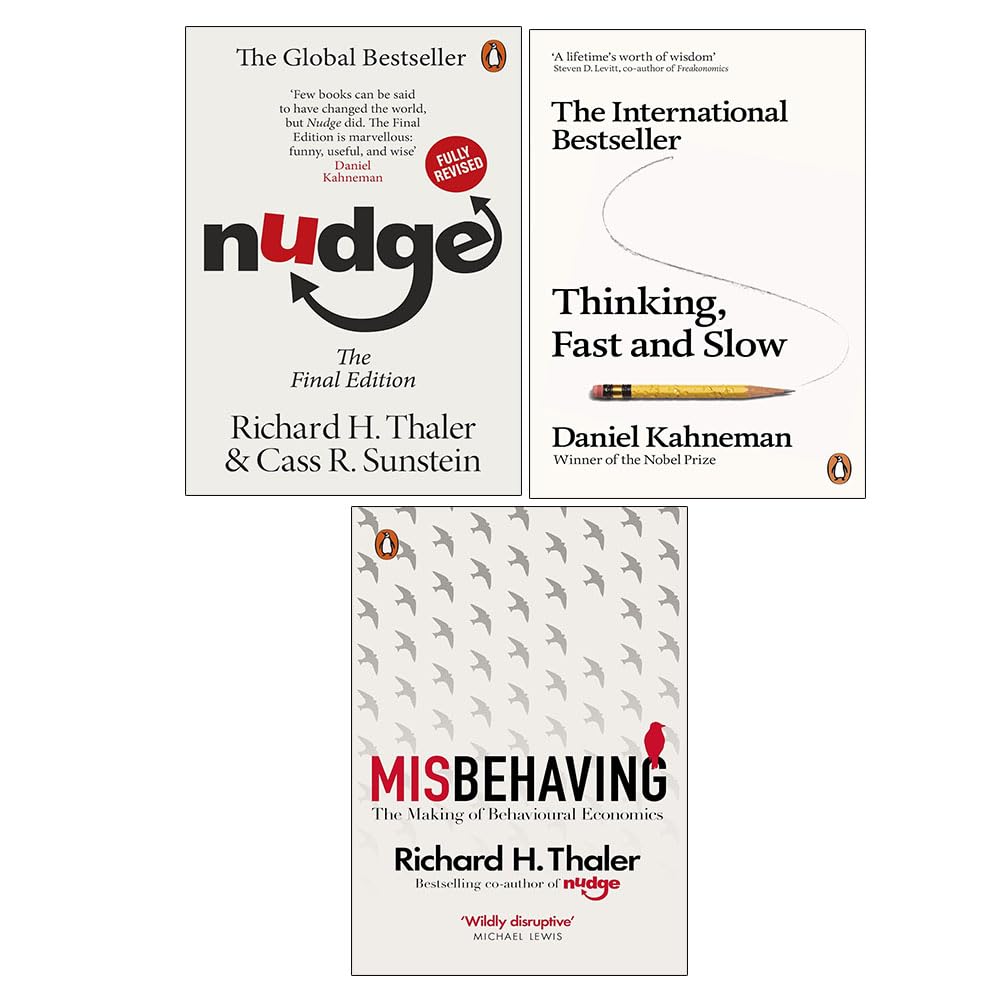
Titles in This Set:
Nudge
Misbehaving
Thinking, Fast and Slow
Format: Paperback
Overview:
This three-book collection brings together three landmark titles in behavioral science and decision making. Nudge reveals how choice architecture can gently steer behavior toward better outcomes, without diminishing freedom. Misbehaving offers a witty, rigorous tour of how real humans diverge from textbook rationality, reshaping economic thinking. Thinking, Fast and Slow guides readers through the twin-system model of thought, exposing how quick impressions and deliberate reasoning compete in every judgment. Together, these works illuminate why people think, decide, and act as they do, and how individuals, organizations, and policymakers can design environments that promote clearer thinking, wiser choices, and more effective actions. It’s an essential non-fiction set for curious minds, students, professionals, and anyone seeking practical insight into how decisions unfold in daily life and in the policy arena.
What This Collection Covers:
At the heart of this trio is a shared question: how do real people make choices under uncertainty and constraint? Nudge shows how subtle nudges—defaults, framing, and accessible options—can improve outcomes in health, wealth, and well-being. Misbehaving digs into experiments that reveal systematic deviations from rational models, illustrating how psychology and behavior shape markets and policy. Thinking, Fast and Slow decodes the interplay between rapid, automatic judgments and slow, careful reasoning, highlighting strategies to counter bias. The collection, as a whole, links individual decision making to broader social consequences, equipping readers with practical frameworks for risk assessment, incentive design, and improved decision making across contexts. It invites readers to rethink everyday choices, from personal finance to public policy, and to recognize the limits of intuition without sacrificing curiosity. With accessible prose and real-world relevance, it supports students, professionals, and lifelong learners in building a more nuanced understanding of how people actually think and act, and how to design systems that help them do better. By connecting theory to practice, this collection becomes a practical companion for study, debate, and daily decision making.
Book-by-Book Guide:
Nudge embraces a practical lens on how choices are presented and how such presentation affects behavior. It explores real-world applications—from retirement planning to health decisions—demonstrating that small, carefully designed defaults and prompts can nudge people toward better outcomes without limiting freedom. The narrative blends psychology, economics, and public policy to show why what looks like a minor setup can shape major results. It’s a vital read for readers who want clear, evidence-based strategies for improving decision making in work, family, and community life. Whether you’re a student, a professional, or simply curious about how everyday environments influence actions, Nudge delivers tangible takeaways you can apply right away.
Misbehaving brings readers into the laboratory and marketplace where human behavior defies the neat assumptions of traditional economics. Through engaging experiments and stories, the book reveals how people often rely on intuition and heuristics, making predictable errors while still driving innovation and economic progress. It argues that incorporating psychological realism into economic theory yields more accurate models and better policy. This collection-friendly guide shows why behavioral insights matter for business strategy, public policy, and personal finances, offering practical lessons on risk, incentives, and decision making. A readable, witty, and thought-provoking journey into the quirks of human judgment that reshapes what we understand about markets.
Thinking, Fast and Slow surveys the two systems that govern our thinking: System 1 works quickly and automatically, while System 2 engages deliberate, effortful reasoning. The book uses a vast array of experiments and examples to illuminate biases, shortcuts, and errors that shape judgments—from everyday choices to high-stakes decisions. It explains why people overestimate rare events, confuse correlation with causation, and trust first impressions. For readers seeking a deeper grasp of why we think the way we do, this work offers a comprehensive framework to improve thinking, decision making, and critical evaluation across contexts.
Who This Set Is Perfect For:
This collection is ideal for adult readers who crave evidence-based insight into human behavior and decision making. Students of economics, psychology, public policy, and business will find foundational concepts presented with clarity and relevance. Professionals seeking to apply behavioral insights to strategy and operations will benefit from concrete examples and transferable ideas. It also makes a thoughtful gift set for book clubs, classrooms, and policy-minded readers who enjoy non-fiction that challenges assumptions. If you enjoy exploring biases, incentives, and the quirks of judgment, this collection is a compelling, trusted companion.
Key Benefits:
- Comprehensive three-book collection offering foundational works in behavioral economics and cognitive psychology
- Clear explanations of choice architecture, cognitive biases, and dual-process thinking
- Great for gifting, collecting, and binge-reading non-fiction
- Supports classroom, clubs, and self-guided learning
- Accessible paperback edition with engaging anecdotes and real-world applications
- Valuable for readers seeking to improve decision making in budgeting, health, and policy
About the Author:
This set brings together three landmark non-fiction titles by leading thinkers in behavioral economics and cognitive psychology. Each work is celebrated for translating rigorous research into accessible, compelling narratives that illuminate how people think, decide, and behave in the real world. Nudge, Misbehaving, and Thinking, Fast and Slow have influenced policy discussions, business strategy, and everyday understanding of human behavior. While the authors come from diverse backgrounds, all share a commitment to empirical insight, clear writing, and practical relevance. The collection offers readers a window into the field’s most influential ideas, presented in a way that makes them usable for study, discussion, and personal growth.
Why You’ll Love This Set:
If you’re seeking an intelligent, readable path into how people make decisions, this trio delivers. The blending of accessible storytelling with evidence-based analysis makes complex concepts feel practical and applicable. Owning all three titles creates a coherent journey through decisions, biases, and thinking strategies, offering a durable resource for study, discussion, and reference. It’s a trusted gift set for curious readers, students, and professionals who want to understand the levers behind choices—from everyday purchases to public policy.
Please Note: The individual books included in this listing will be dispatched as per the original UK ISBN and UK edition cover image shown in the image.
- Choosing a selection results in a full page refresh.