

1
1
✔ In stock and ready to ship
🚚 Order within calculating... to receive it by
calculating...
✅ Fully tracked delivery on every order
📦 Tracking details sent instantly when your order ships
⭐⭐⭐⭐⭐ 4.8/5 rating from 7,500+ verified customers
🔒 Secure checkout with Visa, Mastercard, Amex, PayPal & Shop Pay
SKU:
MAN-LOWPLEX-ACT-U02-139881184X
Barcode:
9781398811843
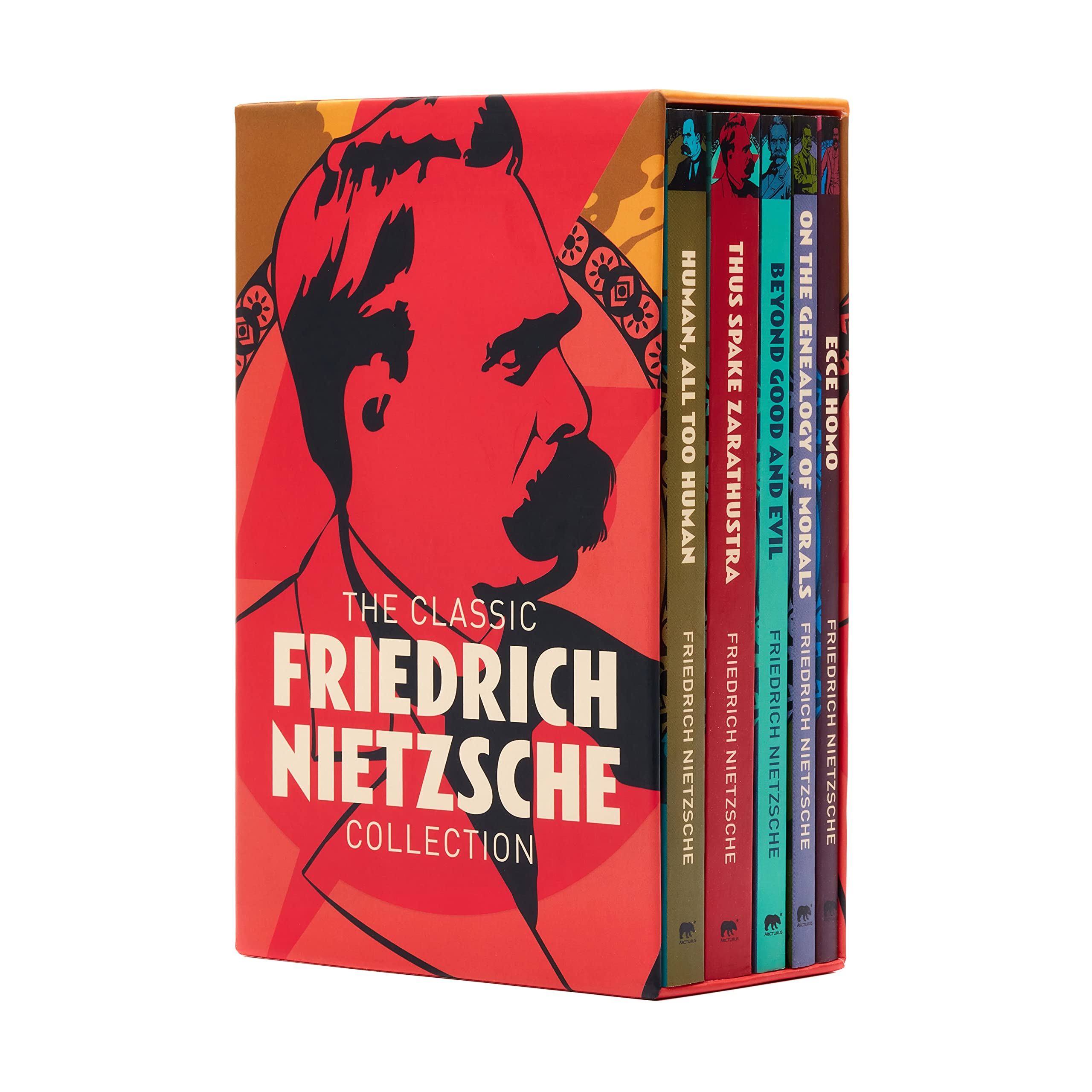
Titles in This Set:
Human, All Too Human
Thus Spoke Zarathustra
Beyond Good and Evil
On the Genealogy of Morals
Ecce Homo
Format: Paperback
Overview:
The Classic Friedrich Nietzsche Collection brings together five foundational works in a single, inviting paperback boxed set from Arcturus Classic Collections. This edition spotlights Nietzsche’s probing intellect across a spectrum of themes, from psychology and culture to morality and self-creation. Translated by a distinguished panel—Thomas Common, Gerta Valentine, Helen Zimmern, and Horace B. Samuel—the texts maintain accessibility while preserving Nietzsche’s incisive, provocative voice. The boxed set format makes a thoughtful gift for students, readers of philosophy, and anyone curious about the roots of modern thought. With its compact paperback design and carefully curated selection, this collection offers an approachable entry point to Nietzsche’s challenging ideas, as well as a portable reference for coursework, discussion groups, or personal exploration. Whether you’re revisiting his classic critiques or encountering them for the first time, the set opens doors to a deeper conversation about culture, power, and human potential.
What This Collection Covers:
This quintet traces Nietzsche’s unflinching examination of what it means to think freely within a culture’s inherited moral framework. Human, All Too Human launches with aphoristic explorations of psychology, religion, art, and social norms, inviting readers to question received wisdom. Thus Spoke Zarathustra follows with poetic, paradigmatic prose that challenges conventional morality and invites readers to reinvent themselves. Beyond Good and Evil sharpens the critique, urging readers to interrogate the assumptions behind “good” and “evil” and to adopt a perspectival stance toward all truths. On the Genealogy of Morals delves into the origins of moral values, revealing how historical conditions shape ethical systems. Ecce Homo closes the circle with a candid, self-portrait-like reflection on Nietzsche’s own life and works, offering context for the provocative ideas that precede it. Together, the five volumes present a coherent journey through existential questioning, cultural critique, and the call to personal authenticity.
Book-by-Book Guide:
Human, All Too Human: In this collection of essays and aphorisms, Nietzsche turns his analytic eye on human nature, culture, and religion. The tone is lucid and probing, blending psychology with social critique to reveal how beliefs are formed and how individuals might freeing themselves from inherited constraints. Readers encounter sharp observations about art, morality, superstition, and the psychology of belief, all framed as a practical, almost clinical, examination of how people think and act. It’s a work that rewards careful reading and re-reading, inviting readers to test ideas against everyday life and societal norms while embracing a more skeptical, self-aware stance toward received wisdom. Thus Spoke Zarathustra: Nietzsche’s most famous and controversial work unfolds as a philosophical novel in which the prophet Zarathustra proclaims radical ideas about overman, freedom, and the critique of herd morality. The narrative form, symbolic episodes, and lyrical passages reward patient engagement as readers trace themes of self-overcoming, joy in creation, and the limits of conventional religion. The book’s sweeping vision invites contemplation of how individuals construct meaning, confront mortality, and cultivate inner strength in a modern world that often feels contradictory and disenchanted. Beyond Good and Evil: A concentrated challenge to traditional moral philosophy, this volume interrogates the origins of moral concepts, the biases of philosophers, and the role of power in shaping value systems. Nietzsche presents a series of incisive critiques and aphorisms that encourage readers to adopt a perspectivist stance—recognizing that “truths” are often shaped by viewpoint, history, and culture. The argument builds toward a provocative reimagining of ethics, urging readers to assume responsibility for their own values rather than accepting inherited norms. On the Genealogy of Morals: This work expands on the historical roots of morality, examining how concepts such as guilt, ressentiment, and ascetic ideals emerged within social structures. Nietzsche’s genealogical method reveals the contingency of moral norms and their influence on individual conduct. The book appeals to readers who enjoy methodological depth, historical context, and philosophical analysis that connects philosophy with psychology, culture, and social change. Ecce Homo: In this personal, self-revealing piece, Nietzsche surveys his own life and writings with characteristic candor and bravado. Ecce Homo invites readers to see the connections between life experience, intellectual stance, and the reception of his work. The tone blends bravado with self-critique, offering insight into how Nietzsche viewed his own contributions and the challenges of communicating provocative ideas to a broad audience. This closing volume provides essential context for understanding the rest of the collection and Nietzsche’s enduring influence on philosophy and literary style.
Who This Set Is Perfect For:
This five-volume collection is ideal for philosophy students, literary scholars, and intellectually curious readers who want a compact, paired-down entry into Nietzsche’s core ideas. It suits university reading lists, philosophy clubs, and gifting situations for graduates or readers exploring existentialism, critical theory, or cultural critique. The accessible paperback format makes it portable for commuting study or library-to-room reading. It also serves as a thoughtful introductory gateway for readers new to Nietzsche who appreciate concise, provocative argumentation that challenges conventional morality and invites personal reflection. Teachers and parents who wish to spark discussions on ethics, history, or modernity will find in these volumes rich material for guided exploration and thoughtful conversation.
Key Benefits:
- Concise, authoritative five-book collection of Nietzsche’s key works
- Accessible paperback edition suitable for study and leisure
- Translations by renowned scholars, preserving clarity and nuance
- Great for reading groups, classrooms, and gift-giving to philosophy lovers
- Connections across works illuminate the development of Nietzsche’s thought
- Compact boxed set that fits neatly on shelves and in backpacks
About the Author:
Friedrich Nietzsche remains one of the most influential figures in modern philosophy, renowned for his radical critique of morality, religion, and conventional wisdom. His writings probe the foundations of value, the nature of power, and the human drive toward self-creation. Nietzsche’s sharp aphorisms, prophetic provocations, and poetic prose have shaped existentialism, post-structuralism, and contemporary debates about meaning, authenticity, and culture. While his ideas provoked controversy in his own era, they continue to provoke thought and inspire readers to question assumptions, test ideas against experience, and imagine new ways of living. The translators and editors who contributed to this collection help bring theseCompelling insights to a broad audience in accessible, readable form.
Why You’ll Love This [Set/Collection/Box Set]:
If you’ve been seeking a curated, high-quality gateway into Nietzsche’s essential works, this boxed set delivers. The five-titles-in-one package provides a coherent arc—from psychological observations to radical critiques of morality and a personal self-portrait—making it easier to compare ideas, track intellectual progression, and discuss themes in a group or class. The paperback format offers portability and affordability, while the translations preserve fidelity to Nietzsche’s original voice. Whether you’re studying for a course, building a philosophy library, or gifting a thoughtful, enduring set to a reader who loves deep questions, this collection offers substantial intellectual value and lasting relevance.
Please Note: The individual books included in this listing will be dispatched as per the original UK ISBN and UK edition cover image shown in the image.
- Choosing a selection results in a full page refresh.