

1
4


✔ In stock and ready to ship
🚚 Order within calculating... to receive it by
calculating...
✅ Fully tracked delivery on every order
📦 Tracking details sent instantly when your order ships
⭐⭐⭐⭐⭐ 4.8/5 rating from 7,500+ verified customers
🔒 Secure checkout with Visa, Mastercard, Amex, PayPal & Shop Pay
SKU:
MAN-VRT-PNG-U251440-9789124315696
Barcode:
9789124315696
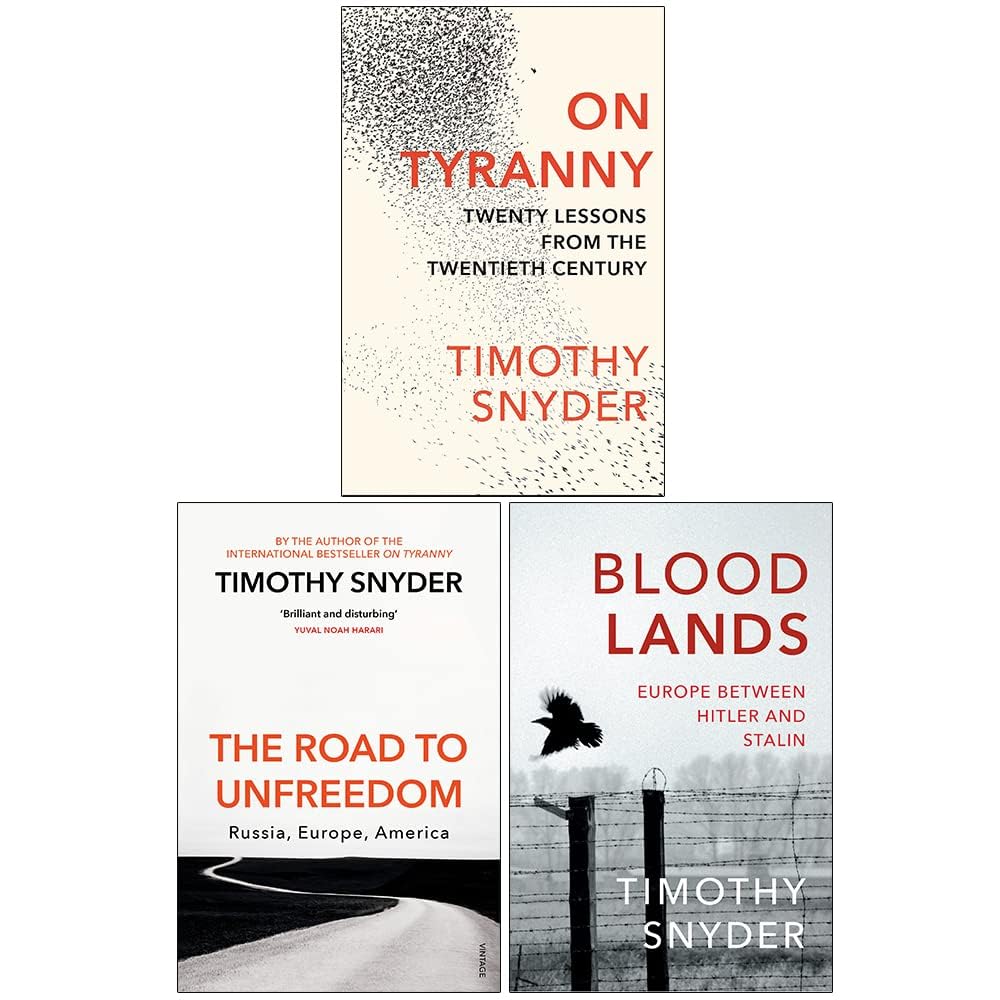
Titles in This Set:
On Tyranny
The Road to Unfreedom
Bloodlands
Format: Paperback
Overview:
Timothy Snyder’s three-book collection brings together a rigorous, provocative examination of democracy, power, and memory. On Tyranny offers a concise, urgent meditation on defending democratic norms and institutions when rhetoric and authority threaten to hollow them from within. The Road to Unfreedom analyzes how contemporary politics intersect with Russia’s influence operations, highlighting real-world events from the 2014 Ukraine crisis to cyber activity during the 2016 elections and beyond, and showing how these dynamics shape political life in the West. Bloodlands surveys a stark chapter of European history, detailing the mass killings carried out by Nazi and Soviet regimes across a region from Berlin to Moscow. Together, these volumes provide a cohesive, accessible lens on how totalitarian temptations endure, how information and power intersect, and why memory matters for safeguarding liberty. This paperback collection is essential for thoughtful readers seeking a deeper understanding of today’s political moment, its origins, and its risks. Snyder’s clear prose, careful sourcing, and disciplined analysis make this set a vital addition to any non-fiction shelf.
What This Collection Covers:
Across these three works, Snyder traces the mechanisms by which democracies can falter and the ways authoritarian impulses reassert themselves in the modern era. On Tyranny emphasizes vigilance, civic engagement, and ethical leadership as antidotes to creeping autocracy, offering a framework for recognizing subtle erosions of democratic norms. The Road to Unfreedom decouples political rhetoric from reality, revealing how misinformation, strategic narratives, and geopolitical maneuvering—especially by Russia—reshape Western politics, alter public perception, and influence policy choices. Bloodlands centers historical memory on Europe’s darkest years, exposing how systemic violence, ideological extremes, and territorial ambition produced staggering loss. The collection invites readers to connect past and present, to question simple explanations, and to consider what citizens, educators, and policymakers can do to defend pluralism, truth, and accountability in a contested world. The tone remains rigorous yet accessible, making complex histories feel relevant to today’s readers and students alike.
Book-by-Book Guide:
On Tyranny presents a compact, forceful argument about the fragility of democratic life and the everyday choices that either uphold or undermine freedom. Snyder outlines historical patterns of populist movements and how ordinary citizens can respond with informed civic action, institutional safeguard, and a commitment to truth. The emphasis is on concrete, practical steps that individuals and communities can take to resist demagogic tides without surrendering core democratic values. The writing is precise, lucid, and urgent, inviting readers to reflect on the responsibilities of citizenship in times of political strain. This volume serves as a timely companion for readers seeking clarity about how to sustain liberty in challenging circumstances.
The Road to Unfreedom investigates the modern political landscape through the lens of geopolitics, media, and state power. Snyder dissects the ways in which external actors, especially Russia, exploit Western divisions, amplifying polarisation and eroding trust in institutions. The narrative threads together events from the Ukraine crisis to cyber operations and the information wars surrounding elections, offering a provocative portrait of contemporary influence campaigns. The analysis is meticulous, linking historical patterns to current phenomena, and encouraging readers to examine the reliability of sources, the architecture of media ecosystems, and the consequences of policy choices on national sovereignty.
Bloodlands centers on a devastating period in European history, illuminating how the Nazi and Soviet regimes together inflicted mass violence across a broad geographic swath. Snyder details the scale and mechanics of atrocities in a region he terms the Bloodlands, highlighting the human cost and the political calculations that enabled such crimes. The work blends archival research with narrative clarity to reveal how totalitarian ideologies intersect with war, occupation, and population displacement. This book provides historical context for debates about memory, responsibility, and the boundaries between political violence and state policy.
Who This Set Is Perfect For:
This collection is ideal for readers who want a coherent, deeply researched perspective on democracy, global politics, and modern history. It’s well suited to students and educators seeking a robust foundation for discussions about authoritarianism, civil society, and the consequences of geopolitical maneuvering. It also appeals to readers who enjoy rigorous non-fiction that connects past events to present-day debates, as well as book clubs looking for thematically linked titles that illuminate the fragility of democratic norms. Gift buyers will find substantive, thought-provoking volumes that challenge assumptions and foster informed conversations about power, memory, and responsibility in the modern world.
Key Benefits:
- Three interconnected perspectives on democracy, power, and memory in a single, cohesive set
- Accessible paperback format for comfortable, long-form reading and study
- Rich historical context paired with contemporary analysis for classroom use or personal study
- Clear, evidence-based argumentation that encourages critical thinking about current events
- Strong thematic throughline: vigilance, accountability, and the defense of pluralism
- Ideal for readers seeking a complete module on Europe’s 20th century history and its echoes today
About the Author:
Timothy Snyder is a historian whose research centers on Eastern Europe, mass violence, and the political uses of history. As a scholar and public intellectual, he has written several influential works that interrogate how societies remember the past and respond to threats to democratic governance. His books—On Tyranny, The Road to Unfreedom, and Bloodlands—reflect a consistent focus on the fragility of liberal democratic norms and the importance of informed citizenship. Snyder’s rigorous, accessible approach combines archival scholarship with contemporary relevance, inviting readers to think critically about power, ideology, and the responsibilities of individuals and communities in safeguarding human rights and democratic pluralism.
Why You’ll Love This Set:
If you crave a well-structured, thought-provoking exploration of how democracy evolves and sometimes deteriorates, this collection delivers. The three titles build a comprehensive narrative—from the daily choices that sustain liberty to the geopolitical dynamics that threaten it, and the historical memory that informs our present. The knowledge, insights, and readability converge to make this set a durable reference for lifelong learners, students, and policy-minded readers alike. Owning the complete collection provides a robust framework for understanding the roots of today’s political challenges and the enduring importance of critical thinking, civic engagement, and evidence-based analysis.
Please Note: The individual books included in this listing will be dispatched as per the original UK ISBN and UK edition cover image shown in the image.
- Choosing a selection results in a full page refresh.